Introducing AudioNimbus: Steam Audio’s Immersive Spatial Audio, Now in Rust
Spatial audio simulation has become increasingly important for immersive applications in gaming, VR, and interactive media. Today, I’m releasing AudioNimbus, a Rust wrapper around Steam Audio that provides safe, ergonomic access to these spatial audio capabilities.
Steam Audio
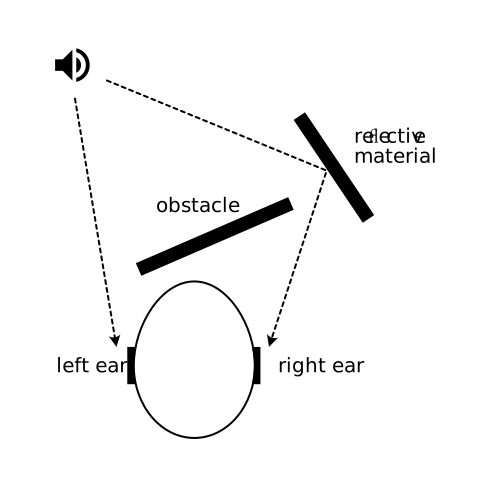
Steam Audio is a software toolkit for spatial audio. Audio spatialization is the process of manipulating sound to create the perception that it originates from a specific direction or distance. It can also replicate the effect of sound being muffled by an obstacle, or produce reverberation as if the sound is occurring within an enclosed space, such as a hall.
In other words, it simulates how ‘sound props’, placed on a virtual stage around the listener, interact with the surroundings before reaching the listener’s ears. The result is a realistic soundscape—an immersive acoustic environment that mirrors how humans perceive and experience sound in the real world.
Steam Audio is being developed at Valve and is most notably used in games built using the Source 2 engine, such as Half-Life: Alyx or Counter-Strike 2.
Steam Audio officially exposes a C API and plugins for popular game engines. AudioNimbus builds on this foundation by providing an ergonomic Rust interface to Steam Audio, enabling developers to leverage spatial audio in their Rust projects.
AudioNimbus
Rust has been steadily gaining traction in the game development community, thanks to its safety guarantees and performance. While many promising native Rust frameworks are being developed, there is a growing need to bridge the gap between Rust and mature, industry-proven technologies like Steam Audio.
AudioNimbus addresses this gap through two crates:
audionimbus: a safe wrapper around Steam Audio.audionimbus-sys: automatically generated raw bindings to the C API of Steam Audio, thataudionimbususes internally.
Perhaps the best way to demonstrate the library is to hear it in action. The following example shows the result of applying a binaural effect to a monotonic sound. Headphones are recommended to experience the spatial effect.
First, here’s the original sound—a pure sine wave (a simple tone):
Using audionimbus, we spatialize the sound to simulate movement around the listener.
In this example, the sound orbits the listener at a distance of 1 meter, moving at a speed of 5 meters per second.
Here is the result:
The binaural effect is just one of many spatial audio capabilities offered by the library. These include:
- Head-Related Transfer Function (HRTF): Simulates how the listener’s ears, head, and shoulders shape sound perception, providing the accoustic cues the brain uses to infer direction and distance.
- Ambisonics and surround sound: Uses multiple audio channels to create the sensation of sound coming from specific directions.
- Sound propagation: Models how sound is affected as it travels through its environment, including effects like distance attenuation and interaction with physical obstacles of varying materials.
- Reflections: Simulates how sound waves reflect off surrounding geometry, mimicking real-world acoustic behavior.
Together, these effects work in harmony to create a convincing soundscape.
Update (Apr 3, 2025): An interactive demo is now available!
Closing notes
Visuals often receive the lion’s share of attention, relegating audio to an afterthought. This is particularly evident in games, where graphics quality frequently takes center stage, overshadowing the importance of sound design. I firmly believe that embracing immersive audio is key to elevating gaming experiences to the next level, transforming virtual worlds into vibrant spaces that resonate with players. I hope AudioNimbus can contribute to that effort.
The project is open-source and available on GitHub, including code examples and usage documentation. I’d be interested to hear about projects built with AudioNimbus - feel free to reach out and share what you create! Contributions and feedback are welcome.
Happy hacking!